
Approvals
The issue goes through several levels, but the decision still comes back to the owner or CEO.
Distributed authority and a shared management model
We develop a target management model and business architecture. We align authority, management cycles, metrics and the sequence of organisational and technological changes.
Discuss your needsThe issue goes through several levels, but the decision still comes back to the owner or CEO.
As a result, several functions are involved, but a single owner of the result is not fixed.
Goals, budgets, projects, and operational indicators live in different management cycles.
Critical order of action rests on individual leaders and personal agreements.
As a company grows, functions, projects and rules are introduced for individual needs. Each change may be justified, while the overall management model gradually loses coherence.
Departments adopt their own rules, use different metrics and interpret decision rights differently. The loss of control appears in the connections between functions rather than within each function.
Management is forced to compensate for these gaps with meetings, renegotiations and personal involvement in operational matters.
The task of practice is Define a sustainable management logic: which decisions are made at each level, who is accountable for the result, how goals relate to processes and metrics, and which changes need to be reflected in data and systems.
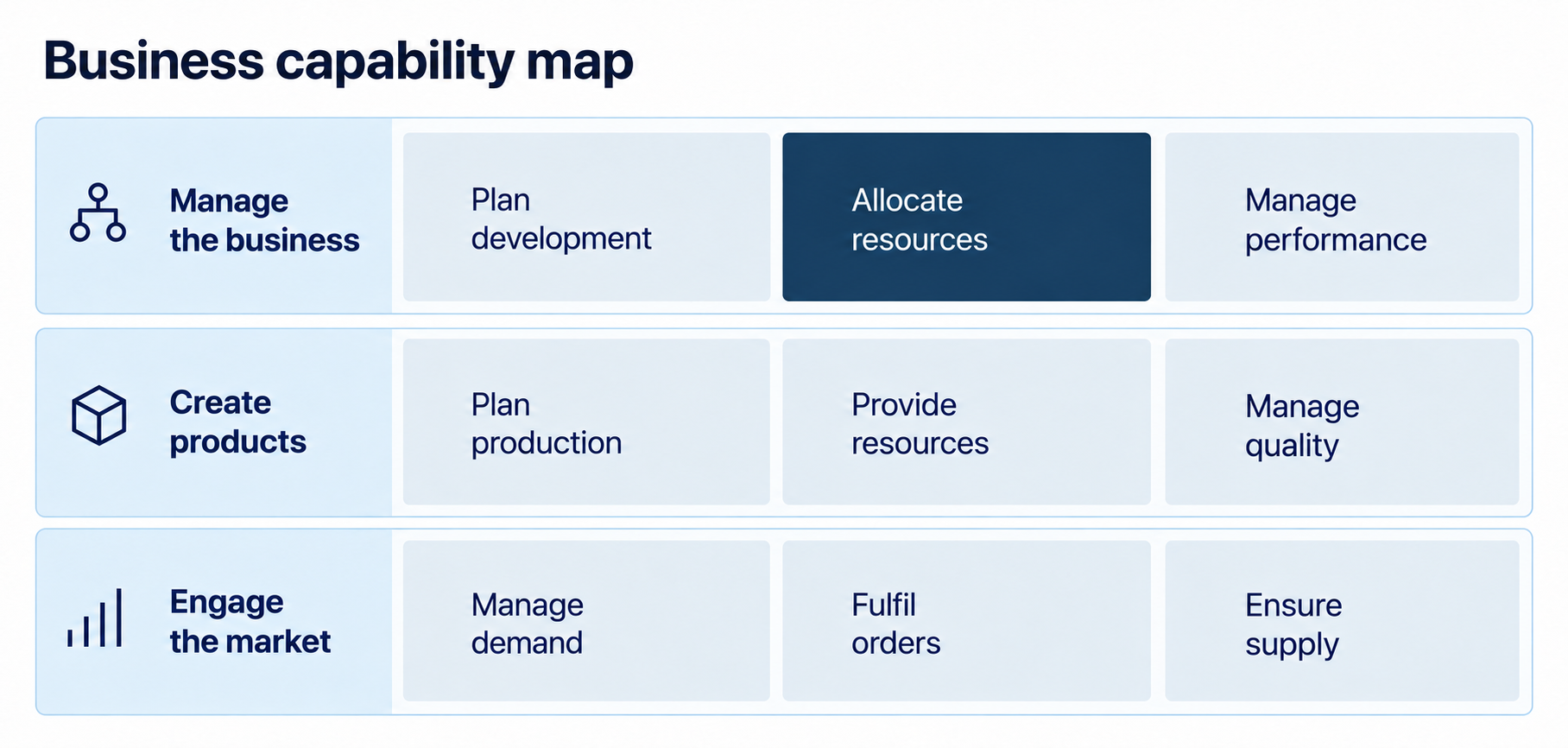
Functions and competencies required to implement the strategy – regardless of the structure and set of systems in place.
Capability scope, required development level, owners and priorities.
Allocation of functions, decision rights and accountability across management levels and departments.
Owners of results, boundaries of authority and vertical accountability.
The sequence of actions from event to result for the customer, production or internal customer.
Workflow, participant roles, handovers, deadlines and process metrics.
Strategic objectives are given to owners, processes, and measurable execution rules.
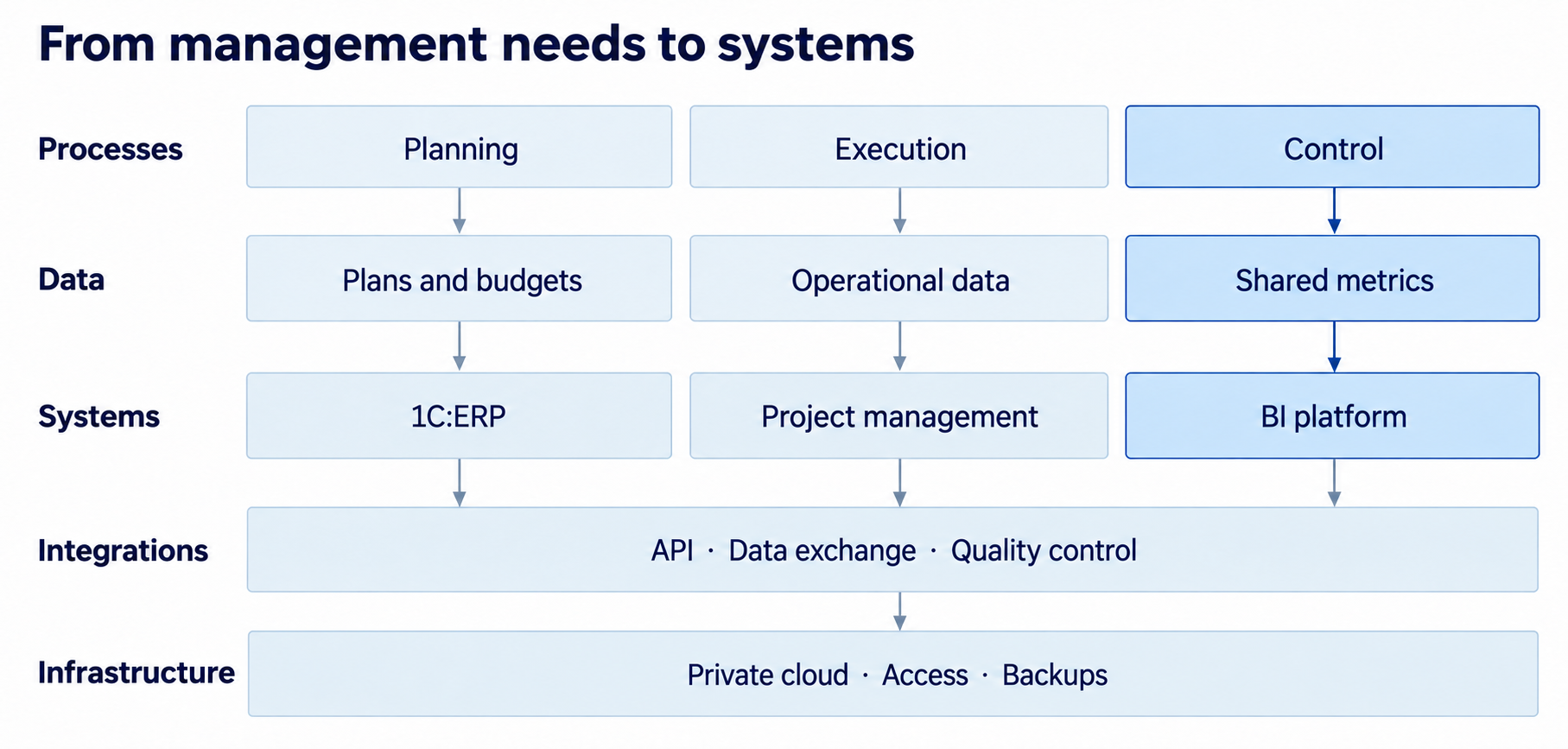
The management model and target architecture must answer three questions together: what the company needs to be able to do, who makes decisions, and how departments work together to deliver results. Decision rights, processes, metrics, data and systems are defined around the same management decisions. Automation can therefore proceed in parallel when it follows a shared approach to accountability and data.
Strategy → Goals → Indicators → Priorities for Change
The scope depends on the starting point. Our approach is consistent: record how management actually works, design the target model and embed it in managers’ regular work.
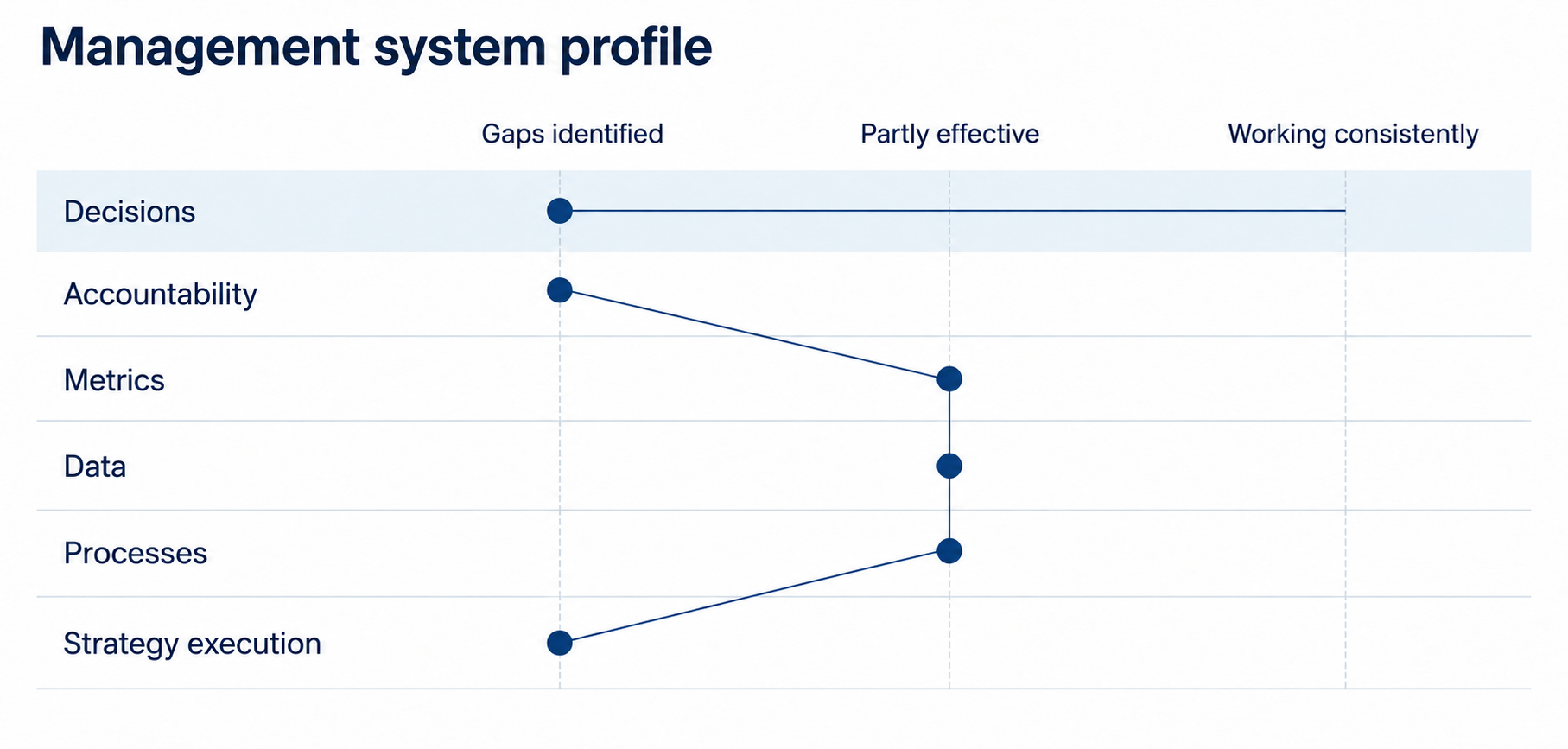
We look at how decisions are being made: where returns arise, what data is used, who actually affects the result and what is not formally fixed.
Decisions go through several layers, but the actual logic of choice, data, and participants are not anchored.
We document the decision path, participant roles, data used, escalation grounds and the actual result owner.
It is clear where there is a delay, a return to the top level or a break in responsibility.
We define decision levels, authority, result owners, management cadence, metrics and escalation rules.
Authority, responsibility, and indicators are defined by function, but are not related to decision classes and outcomes.
We determine the levels of decisions, the owners of the result, the boundaries of authority, the managerial rhythm and the rules of escalation.
Each decision category has clear preparers, decision-makers, result owners and grounds for escalation.
Determine which capabilities, processes, data, systems, and initiatives should support the new management logic.
Projects, systems, and initiatives develop as separate function requests and are not always linked to the target management model.
Link business capabilities, processes, data, systems, and initiatives to target decisions, metrics, and outcome owners.
Each initiative has a defined capability, management outcome and dependencies on data or systems.
Form a change plan, leadership roles, regular control formats and criteria for verifying the results.
The changes are described in the project materials, but are not built into the regular work of managers.
Form a transition plan, leadership roles, management formats, control points and criteria for consolidating changes.
The new model is used in regular control cycles rather than being a separate design description.
Project formats and results that can be used as a stand-alone project or as part of a change program.
A map of management gaps: where decisions are escalated back to senior management, where accountability is unclear, and which metrics, data and processes do not support strategy execution.
A structured description of what the company must be able to do to execute its strategy: key capabilities, owners, constraints and priority areas for development.
A decision-making model: levels of authority, participant roles, areas of accountability, management domains and grounds for escalation.
A target architecture showing which processes, data, systems, integrations and infrastructure elements must support the management model.
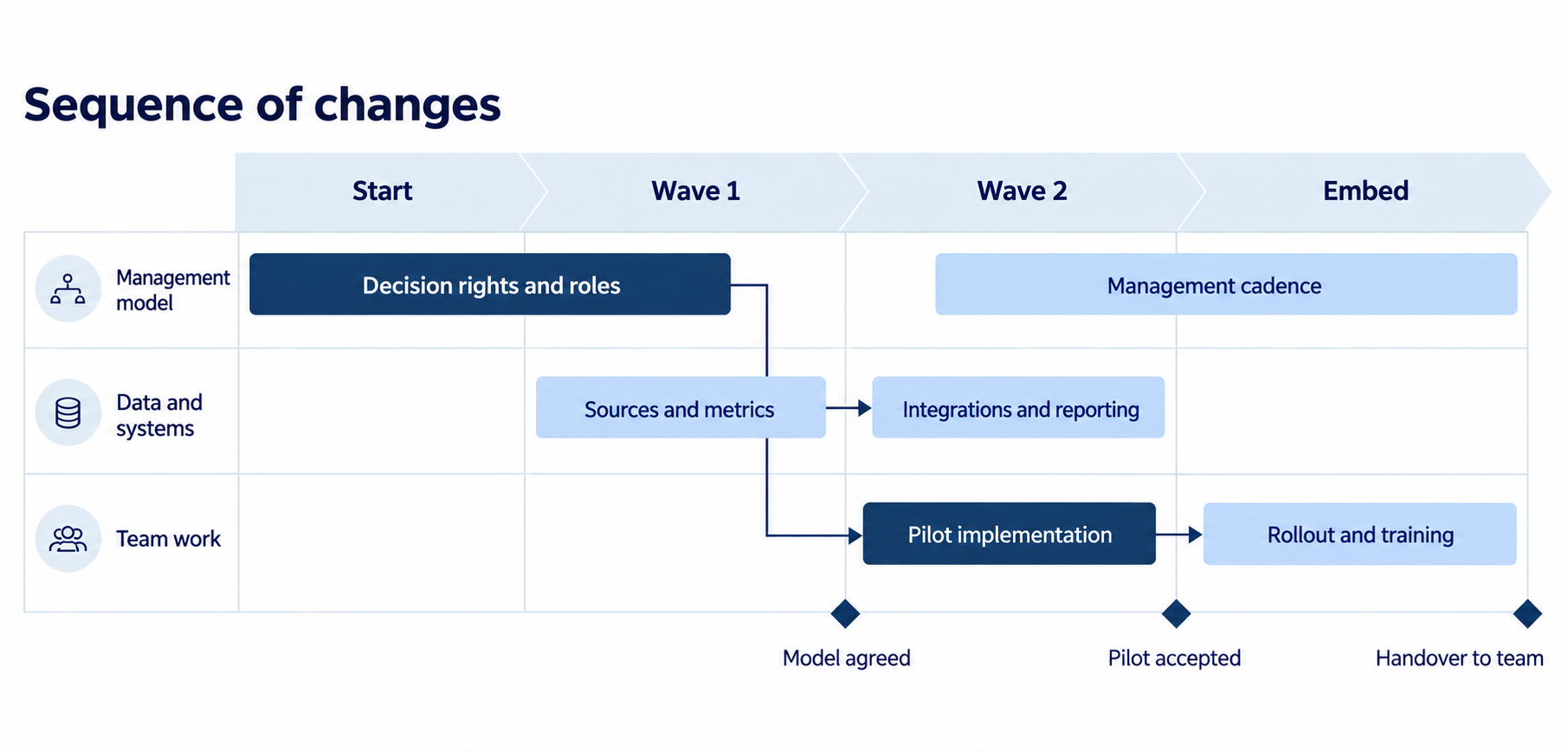
A sequence of changes with priorities, dependencies, initial steps, projects, architecture decisions and checkpoints.
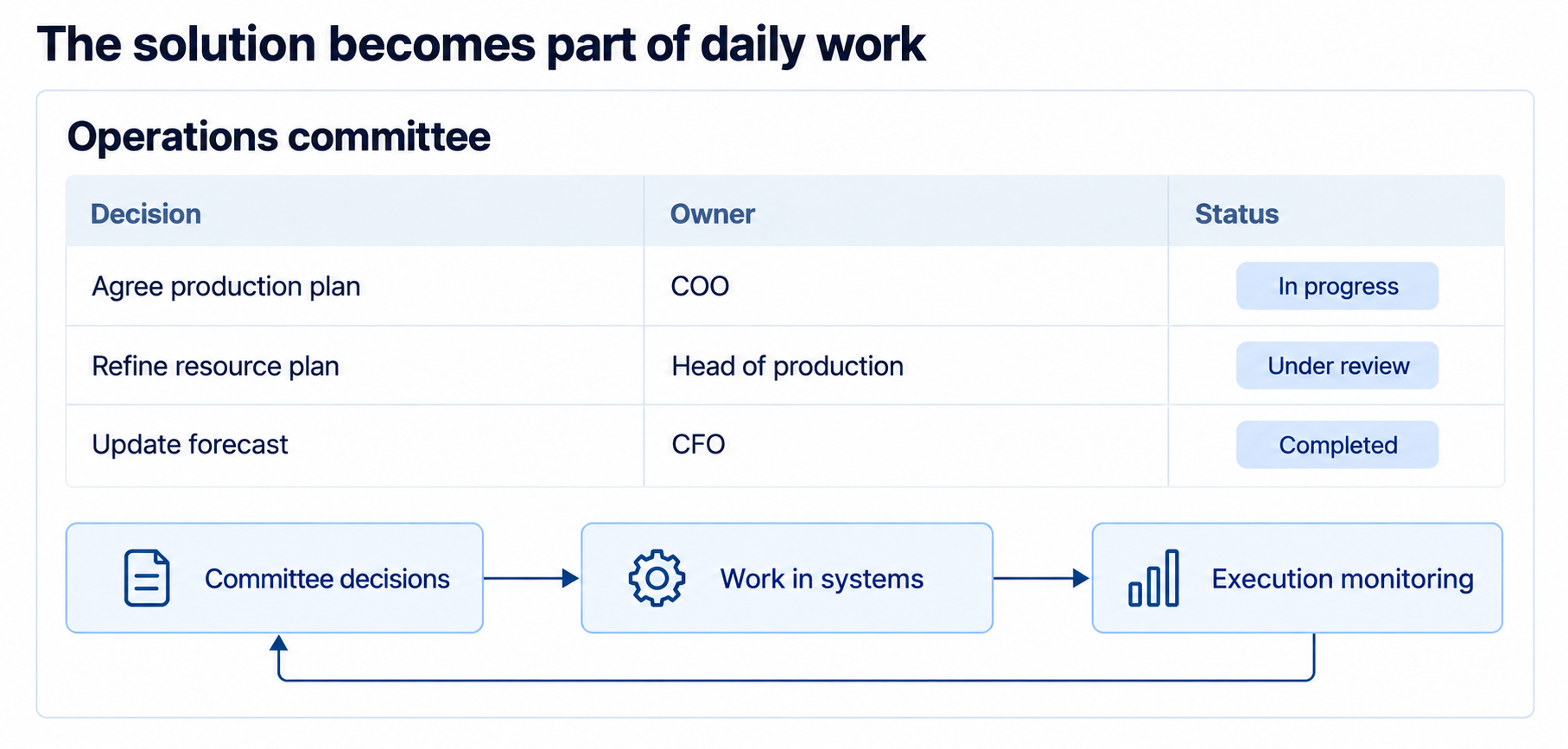
The new model is embedded in management routines, procedures, roles, project decisions and working systems, including management, enterprise and industry-specific platforms that record accountability, status and execution controls.
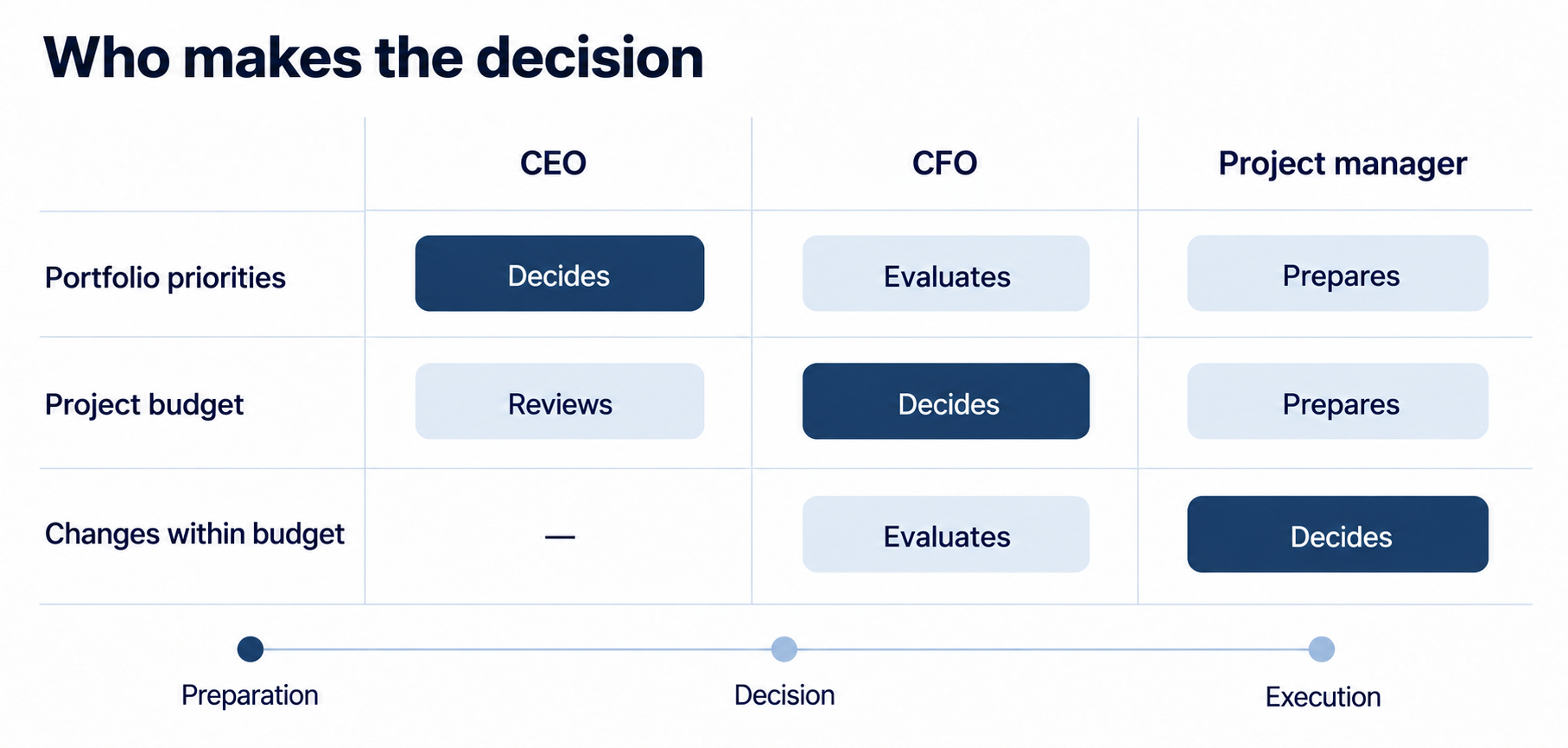
Decision categories, decision-making levels, participants, deadlines and escalation grounds.
| Role/zone | Preparation | Approval | Approval | Implementation |
|---|---|---|---|---|
| Board of Directors | Approval | |||
| Board | Approval | |||
| CEO | Approval | |||
| Financial block | Preparation | |||
| Strategy block | Preparation | |||
| Product block | Implementation | |||
| Operations block | Implementation | |||
| IT unit | Approval |
Owners of the result, boundaries of authority, areas of preparation and approval of decisions.
| Committee | Jan | Feb | Mar | Apr | May | Jun | Jul | Aug | Sep | Oct | Nov | Dec |
|---|---|---|---|---|---|---|---|---|---|---|---|---|
| Strategic committee | Not scheduled. | Not scheduled. | Scheduled. | Not scheduled. | Not scheduled. | Not scheduled. | Scheduled. | Not scheduled. | Not scheduled. | Not scheduled. | Scheduled. | Not scheduled. |
| Product Committee | Not scheduled. | Not scheduled. | Not scheduled. | Scheduled. | Not scheduled. | Not scheduled. | Not scheduled. | Not scheduled. | Not scheduled. | Not scheduled. | Not scheduled. | Not scheduled. |
| Finance committee | Not scheduled. | Not scheduled. | Not scheduled. | Not scheduled. | Not scheduled. | Not scheduled. | Not scheduled. | Not scheduled. | Scheduled. | Not scheduled. | Not scheduled. | Not scheduled. |
Calendar of committees, cycles of planning, control, review of objectives and portfolio.
How strategy translates into indicators, budgets, projects and responsibilities at specific levels.
| Priority | Business capabilities | Processes | Data | Systems |
|---|---|---|---|---|
| High priority | Client experience | End-to-end processes | Single data warehouse | Single platform |
| Medium priority | New products | Automation | Analytics and AI | Integration |
| Low priority | Support functions | Regulations and standards | Data quality | Technical infrastructure |
What business capabilities, processes, data, and systems need to evolve first?
Sequence of implementation, rapid changes, dependencies and checkpoints.
Results are visible in the management decision path: who makes the decision, which data informs it, when it is due and what happens when a variance occurs.
Decision categories are not differentiated by risk level, budget or impact on results.
Decision routes show why an issue is resolved at a particular level or escalated.
Strategic objectives have not been translated into a single sequence of budgets, plans, indicators and initiatives.
Each goal has an owner, metric, review period, associated actions and data source.
Initiatives are based within functions and are not always linked to the target management model and architecture.
For each initiative, the target result, owner, dependencies, necessary resources and completion criteria are recorded.
New companies, sites and divisions create their own management rules, indicators and coordination routes.
The roles of the corporate centre and the new unit, common indicators, control formats and the order of escalation are recorded.
Decision-making and critical knowledge depend on individual managers and professionals.
Replacing a manager or changing a structure does not require restoring work order through personal arrangements.
Practice is necessary when the scale or structure of a business changes faster than the management model.